

Building Bridges. Organizational Clarity. Translating Business into People. Translating People into Business.
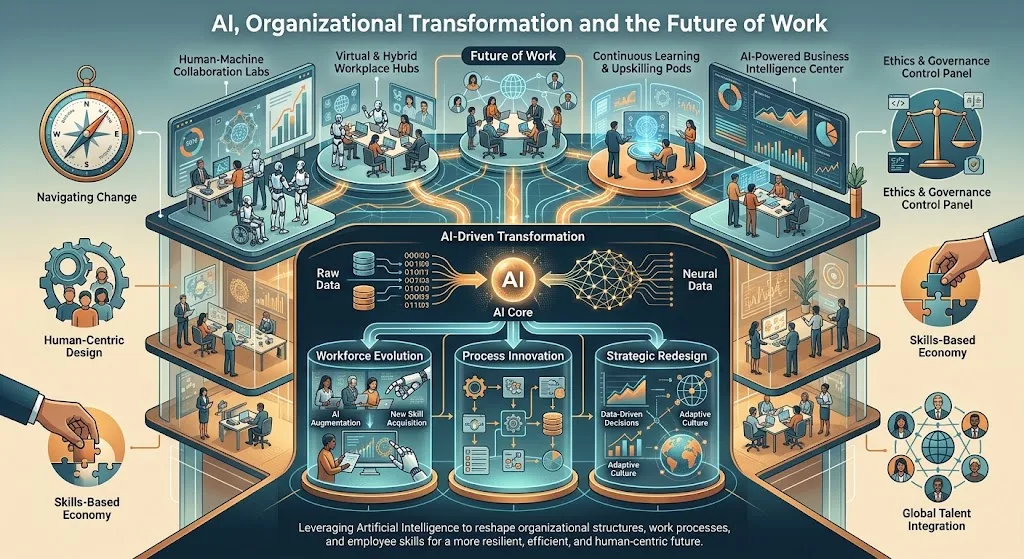
Artificial Intelligence is no longer a future possibility. It is already transforming the way
organizations operate, how decisions are made, how work is performed, and ultimately,
how value is created.
As HR professionals and business leaders, we should not ask whether AI will change
work. That transformation is already happening. The real question is whether we are
prepared to lead it responsibly.
From my perspective, organizations should embrace AI as early and as extensively as
possible—not because technology is replacing people, but because it has the potential
to elevate human contribution.
AI brings remarkable benefits: increased productivity, faster decision-making, greater
operational consistency, better access to information, and the automation of repetitive
tasks. These advantages enable organizations to become more agile and competitive while allowing employees to focus on the activities where humans create the greatest value: critical thinking, creativity, innovation, collaboration, empathy, complex problem-solving, and sound judgment.
This is where the real opportunity lies.
The future of work is not about replacing people with technology. It is about allowing people to spend less time on repetitive execution and more time on meaningful contribution.
However, successful AI adoption should never become a one-sided business benefit.
If organizations capture significant productivity gains through AI, employees should also benefit from this transformation.
Those benefits may take many forms: more meaningful work, increased learning opportunities, greater autonomy, better work-life balance, enhanced wellbeing, career development, or fair recognition of the additional value created through technology.
Transformation is sustainable only when value is shared.
As AI becomes integrated into daily operations, jobs will inevitably evolve.
Responsibilities will shift. Some tasks will disappear while new capabilities become
essential. This evolution should not be viewed as a threat but as a natural consequence
of technological progress—one that has accompanied every major industrial and digital
revolution.
What becomes increasingly valuable is not the ability to execute routine tasks, but the
ability to interpret complexity, challenge assumptions, exercise ethical judgment, and
make responsible decisions.
This is precisely where human intelligence remains irreplaceable.
No matter how advanced AI systems become, they fundamentally operate on
algorithms, probabilities, and patterns learned from existing data. They do not possess
genuine understanding, accountability, moral reasoning, or contextual awareness in the
way experienced professionals do.
- AI can generate options.
- People make decisions.
- AI can identify patterns.
- People understand meaning.
- AI can accelerate execution.
- People define purpose.
The organizations that will thrive in the coming years will not necessarily be those that
invest the most in technology. They will be those that successfully combine
technological capability with human judgment, organizational trust, and responsible
leadership.
For HR, this represents a profound opportunity.
HR is uniquely positioned to bridge business strategy with human capability, ensuring
that technology serves people as much as people serve business. This means
redesigning roles, developing future skills, supporting continuous learning,
strengthening leadership capabilities, and fostering organizational cultures where
innovation and wellbeing coexist.
The future of work is not simply an AI transformation. It is a human transformation, enabled by technology.
Organizations that understand this distinction will not only become more productive—they will become more resilient, more innovative, and ultimately, more sustainable.
Because the future will not belong to organizations with the best technology alone.
It will belong to organizations that combine the power of Artificial Intelligence with the
wisdom of Human Intelligence.
Academic & Research
World Economic Forum – The Future of Jobs Report 2025 https://www.weforum.org/reports/the-future-of-jobs-report-2025/
OECD – Artificial Intelligence and the Future of Work
https://www.oecd.org/employment/International Labour Organization (ILO) – Generative AI and Jobs
https://www.ilo.org/Stanford University – AI Index Report
https://hai.stanford.edu/ai-indexMIT Sloan School of Management
https://mitsloan.mit.edu/National Bureau of Economic Research (NBER) https://www.nber.org/
HR & People Management
CIPD (Chartered Institute of Personnel and Development)
https://www.cipd.org/SHRM (Society for Human Resource Management)
https://www.shrm.org/WorldatWork
https://worldatwork.org/
Business, Leadership & Organizational Transformation
Harvard Business Review
https://hbr.org/MIT Sloan Management Review
https://sloanreview.mit.edu/McKinsey & Company – State of AI https://www.mckinsey.com/capabilities/quantumblack/our-insights
Deloitte – Global Human Capital Trends https://www.deloitte.com/
PwC – Global AI Jobs Barometer https://www.pwc.com/
KPMG – AI & Future of Work https://kpmg.com/
EY – AI and Workforce Transformation https://www.ey.com
Accenture – Responsible AI https://www.accenture.com/
IBM Institute for Business Value https://www.ibm.com/thought-leadership/institute-business-value
Books:
Erik Brynjolfsson & Andrew McAfee – The Second Machine Age
Erik Brynjolfsson & Andrew McAfee – Machine, Platform, Crowd
Ethan Mollick – Co-Intelligence: Living and Working with AI
Amy Webb – The Big Nine
Ajay Agrawal, Joshua Gans & Avi Goldfarb – Prediction Machines
Thomas H. Davenport & Nitin Mittal – All-in on AI
Kai-Fu Lee – AI Superpowers
Daniel Susskind – A World Without Work
